The debate over which faculty holds primacy in human life—reason or emotion—stands as one of the oldest intellectual inquiries in history. Modern society consistently privileges rationality and intellect, often reducing emotion to an unruly impulse that must be suppressed and regulated. But does this hierarchy reflect empirical reality?
A closer examination of human nature suggests that reason does not govern emotion; rather, emotion governs reason. Demarcating the proper status of emotion is not merely an academic exercise—it is the foundational key to understanding the human self and navigating interpersonal relationships. This essay marks the first installment of a six-part series dedicated to the ontology of emotion.
1. Human Nature and Emotion
1) The Premise of Interpersonal Relations: Who Are We Truly Encountering?
Dale Carnegie, a seminal authority on human relations, offered a maxim that serves as a critical heuristic for interpersonal engagement: "When dealing with people, remember you are not dealing with creatures of logic, but with creatures of emotion, motivated by pride and vanity."
This insight illustrates the profound impact of our ontological assumptions about others. If we operate under the premise that human beings are fundamentally rational and logical, we doom ourselves to perpetual frustration and resentment when confronted with their seemingly incomprehensible behavior.
An even greater danger lies in the cognitive asymmetry this premise creates: viewing others through the lens of absolute rationality leads us to implicitly believe in our own flawless rationality. The conviction that "My position is objectively correct because I have reasoned it through, so why do you refuse to comply?" elevates the self to an absolute standard of judgment.
Consequently, anyone we fail to understand is reflexively dismissed as irrational or wrong. This imposes a form of "epistemic or psychological violence" by forcing others to conform to our own subjective frameworks. To prevent this, we must deconstruct the myth of the rational agent and acknowledge that humans—including ourselves—are primarily emotional beings.
2) The Faculty Hierarchy: "A Thinking Creature of Sensation"
René Descartes, who inaugurated modern philosophy, famously declared, “Cogito, ergo sum”(I think, therefore I am). In his pursuit of foundational truth through radical skepticism, he concluded that the sole indubitable reality was the thinking self. In doing so, Descartes placed human reason at the very epicenter of human existence and crowned it as the ultimate arbiter of judgment.
However, the world-renowned neuroscientist Antonio Damasio directly challenged this entrenched Cartesian paradigm in his seminal work, Descartes' Error. From an evolutionary standpoint, the body and its affective systems predated the development of high-level reasoning by millennia.
Consequently, cognitive reason cannot operate in a vacuum; it functions properly only when built upon a robust emotional foundation. Damasio thus upends the long-standing dogma of rational supremacy, famously concluding that humans are: "...not thinking machines that sense, but sensing machines that think."
Our essential nature is not that of a cold, calculating apparatus, but an affective matrix that feels and perceives before cognitive processing. Reason is merely a secondary, supplementary tool that structures and rationalizes the broad trajectory already mapped out by emotion.
(3) The Architecture of the Brain: Neural Evidence of Emotional Dominance
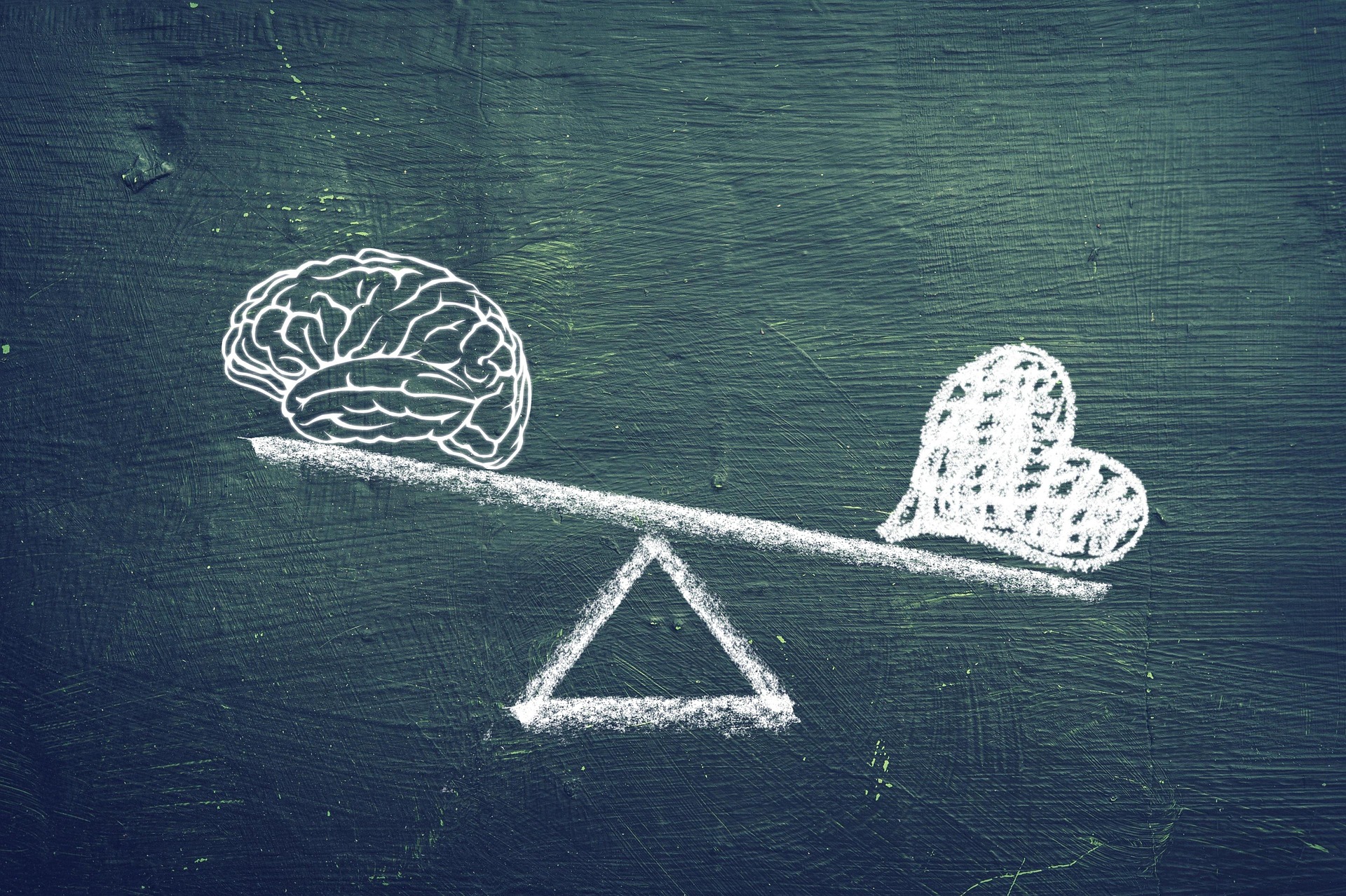
The structural hierarchy wherein emotion supersedes reason is vividly demonstrated by neuroanatomy.
According to physiological research (Carter, 1999), the neural pathways projecting from the limbic system (the emotional center) to the prefrontal cortex (the rational center) are approximately three times more numerous and densely developed than those running in the opposite direction.
The brain is an organ optimized for evolutionary efficiency and survival. The fact that this neural "highway" traveling from emotion to reason has three times the bandwidth of the reverse route clarifies where the true center of behavioral control lies.
This biological asymmetry explains why intense emotional shocks easily hijack rational self-control. The neurochemical and electrical signals by which emotion overwhelms reason are inherently more potent than the top-down cognitive mechanisms available to suppress them. By architectural design, the human brain is hardwired for emotional governance.
2. Decision-Making and Emotion
1) Affect Precedes Intellect: Rationalization as a Post-Hoc Mechanism
We commonly assume that decision-making is a purely rational endeavor—that we systematically weigh costs and benefits, analyze variables, and arrive at an optimized choice. Clinical neurology, however, refutes this assumption.
Consider the famous case of "Elliot," a patient who underwent surgical resection of his orbitofrontal cortex due to a tumor. Although Elliot’s IQ, memory, and analytical faculties remained entirely intact, the trauma severed the connection between his rational cortex and his emotional limbic system. He was rendered incapable of experiencing affect.
The consequences were startling: he became entirely paralyzed when faced with the simplest decisions. As journalist Jonah Lehrer notes in How We Decide(adapting Damasio’s findings):
"He would sit there and, in a kind of Cartesian theater, evaluate and rank the choices... He might spend a half hour, sitting there, deciding where to eat, comparing restaurants on their menu, seating, and lighting. He'd need to compare all of these features and go over them again and again... In the end he generated a cost-benefit analysis, an endless list of pros and cons, for what should have been a simple decision."
Elliot's case proves that human beings cannot arrive at a resolution through pure logic alone. Rational analysis can present options, but only an emotional mechanism—assigning value through "liking" or "disliking"—can close the loop and execute a choice.
In reality, humans rarely like something because they have found a logical reason to do so; rather, we invent reasons because we have already developed an affective preference. Once an implicit, emotional desire is activated, reason acts as a post hoc public relations manager, constructing plausible arguments and justifications to legitimize what emotion has already chosen.
[Insight] Love Is Not a Product of Reason
True affection defies cold calculation. If we love someone strictly due to a checklist of attributes, that relationship is a transactional contract, not genuine love. Love begins with an inexplicable affective pull.
Because emotion favors the individual first, their subsequent quirks and flaws are reframed as endearing—the "reasons" are generated after the fact. If logic maintained primacy, the vulnerability required for love would be biologically impossible.
This profound principle is mirrored in theological texts. In the Judeo-Christian tradition, God’s choice of humanity is explicitly divorced from rational metrics such as merit or utilitarian value, but is framed as an act of sovereign affection:
"The LORD did not set his affection on you and choose you because you were more numerous than other peoples, for you were the fewest of all peoples. But it was because the LORD loved you..."(Deuteronomy 7:7–8)
2) Affect Over Obligation: The Seat of Executive Authority
To fully map human behavior, we must analyze the tripartite dynamic between the Head(cognition/reason), the Heart(affect/emotion), and the Hand(behavioral execution).
Standard behavioral models assume a direct, top-down command structure: the Head determines what is right, and the Hand moves to execute the obligation. However, the introduction of the Heart fundamentally disrupts this chain of command.
No matter how ethically imperative or logically sound the Head’s directive may be, if an individual’s emotions are bruised or alienated during the process, the Hand ceases to function. This is the psychological state of: "I intellectually understand the objective validity of your argument, but I refuse to cooperate because I feel disrespected."
Ultimately, executive authority over whether an action is manifested resides not in the cognitive Head, but in the affective Heart. For reason to guide behavior smoothly, it must continuously monitor and secure the consent of emotion. Consequently, before attempting to direct another's actions, one must first gauge their affective state: "What is the current emotional climate?"
[Insight] Existential Life is Governed by Preference, Not Just Morality
A vast majority of interpersonal conflicts stem not from disagreements over abstract "right and wrong," but from deep-seated currents of "like and dislike." Consider the biblical narrative of Jonah, who defied a divine directive to preach to Nineveh, choosing instead to flee to Tarshish.
Jonah did not refuse the mission because it was logistically or rationally "wrong." His rebellion was driven by intense negative affect—profound resentment and systemic anger toward the geopolitical enemies of his people (Jonah 4:1–2).
We frequently lead with deontological obligation when commanding others, asserting that they must act simply because it is "correct." Yet, if an individual's emotional equilibrium has collapsed, intellectual correctness loses all leverage. True persuasion requires cultivating the heart, rather than merely conquering the intellect.
Conclusion
For centuries, Western intellectual traditions have conditioned us to view emotion as a subordinate faculty—an inferior impulse to be subjugated by the rational mind. Yet contemporary neuroscience and lived human experience tell a vastly different story.
The human being is, at its core, an emotional organism, and reason is the companion that follows the path affect has already cleared. When we pivot to viewing our interlocutors—and ourselves—not as abstract "creatures of logic" but as complex "creatures of emotion," interpersonal friction dissolves, giving way to authentic empathy and existential understanding.
Acknowledging the sovereignty of emotion, however, is not an endorsement of unbridled emotionalism. Precisely because affect exercises such potent systemic authority, we cannot afford to leave it unmonitored. We must confront, understand, and integrate our emotional states with intentionality.


