Among the most corrosive experiences in interpersonal life are resentment and disappointment. We instinctively attribute these to an external cause — the perceived shortcomings or betrayal of another person. Yet a closer look at the psychology of disappointment suggests something less flattering: disappointment is rarely a direct, objective response to another's behavior. More often, it is the product of a gap between reality and a benchmark we ourselves set — our relational expectation.
This can be expressed in a simple working formula: Disappointment = Expectation - Reality
When friction arises in a relationship, the instinctive move is to adjust the "reality" side of the equation — to pressure the other person to change, or to try to engineer the circumstances. But because another person's behavior lies largely outside our control, this approach tends to fail. The second diagnostic indicator in relationship management, then, is to resist the urge to resent an unyielding reality, and instead to audit and recalibrate our own expectations. This piece examines the cognitive patterns behind relational disappointment and proposes several practical strategies for managing them.

1. The Cognitive Roots of Interpersonal Disappointment
Two cognitive patterns, in particular, tend to generate resentment within relationships.
1) Cognitive Imbalance and the Illusion of Equal Exchange
Much interpersonal disappointment stems from an unspoken assumption of strict reciprocity. When we give something to another person, we quietly expect a comparable return — whether emotional, temporal, or material. In practice, however, the ledger between giver and receiver is rarely balanced, and much of that imbalance is not real but perceptual, the product of an asymmetry in memory.
An old saying captures this well: "What the giver remembers is only the good they did; what the receiver remembers is only the hurt they felt." Giver and receiver each retain a selectively favorable version of events. Even after receiving nine kindnesses, a single slight can loom larger in memory than all nine put together — and that single memory ends up shaping the entire relationship.
This tendency has a well-documented empirical counterpart: married couples, asked separately what share of household chores they each perform, routinely report figures that together exceed 100% — commonly around 70% each.[1] The extra 40% is not real; it reflects each partner's tendency to remember their own contributions more vividly than their partner's. This kind of self-serving memory bias helps explain why resentment accumulates so readily even in relationships where giving has, on balance, been mutual.
Scripture offers a striking parallel. In the parable of the sheep and the goats, those who are commended for their righteousness cannot recall having done anything praiseworthy at all, while those condemned protest that they, too, must have done something worthy of note:
"Lord, when did we see you hungry or thirsty or a stranger or naked or sick or in prison, and did not minister to you?" (Matthew 25:44, ESV).
The passage suggests that genuine generosity tends not to keep score of itself — and, conversely, that people are prone to overestimate their own contributions in hindsight. Recognizing this built-in asymmetry — that we remember what we give far more readily than what we receive — is a necessary first step in defusing resentment before it takes hold.
2) Expecting Repayment from the Giver, Rather Than Trusting the Wider Circle
A second source of resentment is the assumption that every exchange must be settled directly between the same two people. It is useful here to distinguish "paying back" — returning a kindness to the person who gave it — from "paying forward" — passing a kindness on to someone else entirely. The love a child pays forward to their own children, rather than back to their aging parents, is a familiar example of the latter.
Within any given relationship, we may find ourselves giving without receiving in return; within another, we may find ourselves receiving without ever having given. Seen across a person's whole network of relationships rather than any single one, the exchange tends to even out. There is little reason to insist that the person who received something be the one who pays it back.
Jesus' parable of the unforgiving servant illustrates what happens when this wider view is lost. A servant, having just been forgiven an almost unpayable debt by his master, immediately turns and demands repayment of a comparatively small sum from a fellow servant. Having just received far more than he could ever return, he nonetheless insists on collecting, in full, from the one person standing in front of him:
"Then his master summoned him and said to him, 'You wicked servant! I forgave you all that debt because you pleaded with me. And should not you have had mercy on your fellow servant, as I had mercy on you?'" (Matthew 18:32-33, ESV).
The servant's error was not generosity but a failure of accounting: he measured his fellow servant's debt against a closed, two-person ledger, forgetting the far larger debt he had just had settled elsewhere. Insisting on repayment from the very person we gave to, rather than trusting that the account balances out across our wider relationships, is a reliable source of needless bitterness.
2. Three Strategies for Managing Relational Expectations
The disciples on the road to Emmaus offer a further illustration of how misplaced expectation, rather than reality itself, produces despair. Their grief was not, strictly speaking, a response to the crucifixion as such, but to the collapse of a specific expectation — that Jesus would be the one to deliver Israel politically: "But we had hoped that he was the one to redeem Israel" (Luke 24:21, ESV).
Notably, the risen Christ does not alter their circumstances to console them; he instead corrects their expectations, opening the Scriptures to show them what they should have expected in the first place. The implication is that many of our own disappointments, too, are resolved not by changing our circumstances but by revising what we expected of them. Three practical strategies follow from this.
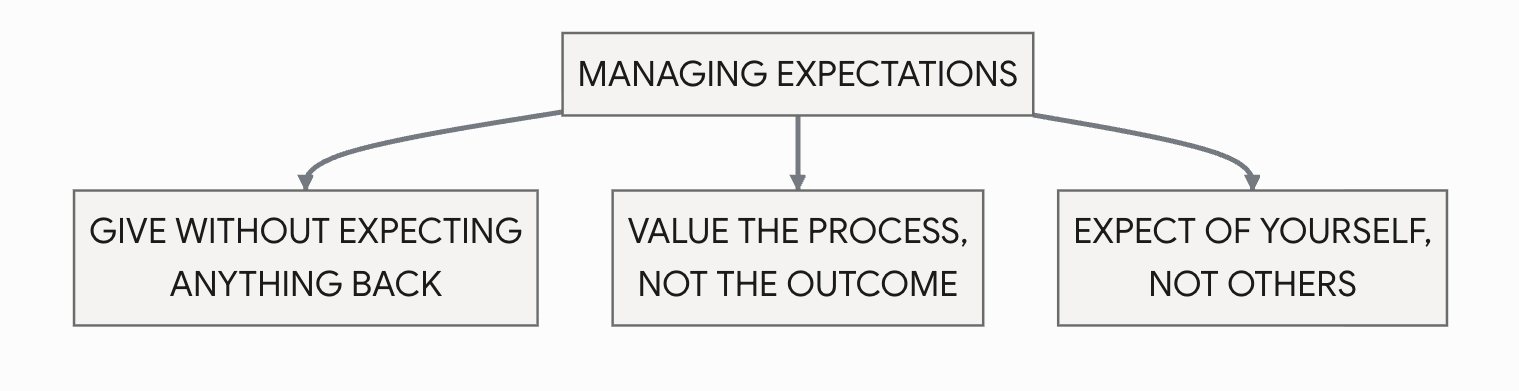
1) Give Only as Much as You Can Give Without Expecting Anything Back
The first strategy is to calibrate our giving so that it stays within the bounds of what we can give without secretly expecting something in return — because a thwarted expectation reliably produces conflict. At best, an expectation that is met leaves us no better off than if we had never held it; at worst, a disappointed expectation leaves us worse off than before.
This lines up with what research on reward prediction error has found about dopamine activity: dopamine is released more strongly in anticipation of a reward than upon actually receiving it.[2] If a reward is unexpected, dopamine rises when it arrives; if a reward is expected, dopamine has already risen during the anticipation, so its actual arrival adds little further boost.
Assuming the reward does eventually materialize, then, the person who expected it and the person who did not end up more or less even. The real asymmetry appears when the reward fails to arrive: without expectation, there is little to lose; with expectation, the shortfall produces a drop below baseline — a "negative" prediction error that registers, psychologically, as disappointment or hurt.
This asymmetry echoes a broader finding in behavioral economics, namely that losses tend to be felt more sharply than equivalent gains are enjoyed.[3] A version of this insight is often summarized in the popular saying "expectation is the root of all heartache" — a line frequently attributed to Shakespeare, though no such line appears in his surviving works, and it is better regarded as a latter-day proverb than an authentic quotation.[4]
The practical implication is to give, lend, or serve only within a range that leaves no room for a secret expectation of thanks or repayment to form. This is often why lending money between friends damages a friendship — not the money itself, but the expectation quietly attached to it. Jesus makes the same point directly:
"But love your enemies, and do good, and lend, expecting nothing in return, and your reward will be great" (Luke 6:35, ESV).
The same applies to acts of service: if the thought arises that others should notice or that some future benefit is owed, that is the moment to pause. Service kept within the bounds of "no expectation" is service that will not later curdle into resentment.
2) Locate the Reward in the Process, Not the Outcome
The second strategy is to shift the source of satisfaction from outcomes, which we cannot control, to process, which we largely can. An outcome may fail to match our hopes, no matter how much effort we invest; pinning our expectations on it is inherently risky. The process itself, however — the doing of the thing — remains within our own hands. Cultivating enjoyment of the activity itself, rather than fixating on what it will produce, is the more resilient posture.
Thomas Edison is widely remembered for saying that he never worked a day in his life, because what he did never felt like work — a remark usually taken to mean that he found his reward in the process of experimentation itself rather than in any particular result.[^5] Had he pinned his satisfaction on outcomes alone, the sheer number of failed experiments behind each success would likely have broken his resolve; because his reward was already located in the process, the outcome had little power to disappoint him.
The Psalms offer a similar reorientation. Watching the wicked prosper while he himself struggled, the psalmist at first grew bitter and envious — until he shifted his focus away from comparing outcomes and toward the process of nearness to God itself, which he found sufficient on its own terms:
"For I was envious of the arrogant when I saw the prosperity of the wicked. For they have no pangs until death... But for me it is good to be near God; I have made the Lord God my refuge, that I may tell of all your works" (Psalm 73:3-4, 28, ESV).
3) Direct Your Expectations Toward Yourself, Not Toward Others
The final strategy is to redirect expectation away from what others may or may not do, and toward what lies within one's own control. Someone whose expectations are pinned on others and someone whose expectations are pinned on themselves tend to weather disappointment very differently.
Expect the weather to be clear, and a cloudy day becomes a letdown; expect instead to make the day enjoyable regardless of the weather, and no forecast can disappoint you. Expect a spouse to remember an anniversary with flowers, and their forgetting stings; ask instead what you might do for yourself on the day, and that expectation cannot fail you.
The prophet Habakkuk models this same redirection in the face of total agricultural collapse — circumstances entirely outside his control:
"Though the fig tree should not blossom, nor fruit be on the vines, the produce of the olive fail and the fields yield no food, the flock be cut off from the fold and there be no herd in the stalls, yet I will rejoice in the Lord; I will take joy in the God of my salvation" (Habakkuk 3:17-18, ESV).
Habakkuk refuses to anchor his joy to figs, grapes, olives, or livestock — none of which he can control. He anchors it instead to his own relationship with God, the one variable that remains within his reach even when everything else has failed.
Conclusion: Toward Relational Equanimity
Recurring resentment and disappointment within a relationship are rarely reliable evidence that the other person is at fault. More often, they signal that our own expectations have quietly drifted out of calibration.
Recognizing our tendency to overestimate our own contributions, trusting that generosity tends to even out across the wider circle of our relationships rather than within any single exchange, and redirecting our expectations toward what we can actually control — the manner of our giving, the process itself, and our own disposition — together form a discipline worth cultivating. Practiced consistently, this discipline keeps our peace of mind from being hostage to circumstances we were never in a position to control in the first place.
Notes
[1]: Ross, M., & Sicoly, F. (1979). Egocentric biases in availability and attribution. Journal of Personality and Social Psychology, 37(3), 322–336.
[2]: Schultz, W. (2016). Dopamine reward prediction-error signalling: a decade on. Nature Reviews Neuroscience, 17(3), 183–195.
[3]: Kahneman, D., & Tversky, A. (1979). Prospect theory: An analysis of decision under risk. Econometrica, 47(2), 263–291.
[4]: The line "expectation is the root of all heartache" is widely, but incorrectly, attributed to Shakespeare; no matching passage exists in his surviving plays or sonnets, and it is best treated as a popular proverb of uncertain origin.
[5]: Edison's remark is widely quoted in slightly varying forms across biographies and interviews; no single authoritative primary source fixes its exact wording, though the sentiment is consistently attributed to him.


