We have now seen how central a role emotion plays in our psychological life and in our relationships. Emotion, we have argued, is a signal — a piece of information we send about our own state, one that, when accurately diagnosed and expressed, has the power to strengthen relationships.
But there is another side to this same capacity. Left ungoverned, the very same emotions that serve us so well can turn destructive, undermining both our inner life and our relationships with others. This piece takes up that other side: how destructive emotion can be governed, examined across three levels — the control of reason, the control of stimulus, and the control of interpretation.
1. The Control of Reason
Trying to govern emotion directly is harder than it sounds. Emotion arises through several distinct pathways, and one of the most important is interoception — the sensory information the body continuously sends about its own internal state.
We tend to assume that the brain governs the body, but the traffic actually runs the other way to a striking degree: reportedly, the volume of signal traveling from the gut to the brain outnumbers the volume of signal traveling from the brain to the gut by more than 2,000 to 1. Physiologically, we are governed by the body far more than we like to admit.
Does the heart race because we feel anxious, or do we feel anxious because the heart is racing? Surprisingly, the second causal direction is real. When the brain misreads a bodily signal, it can manufacture an emotion with no external referent at all — and because we cannot control that internal signal directly, we cannot simply reason such an emotion away.
The workable strategy, then, is not to fight the uncontrollable interoceptive signal but to work with what we can control: external sensory input. Choosing to look at something beautiful, listen to music we love, eat something we enjoy, breathe in a pleasant scent, or feel a comforting texture — each of these choices sends the brain a stream of positive sensory information capable of outweighing a negative internal signal, and in doing so genuinely helps regulate emotion.
Beyond this, there are cognitive strategies — choices reason itself can make — that offer further leverage over emotion.
1) The Emotion Time Delay Creates
The first emotion we need to learn to govern is the one produced by a simple delay in the brain's wiring. Sensory information travels along two distinct neural pathways. One runs through the thalamus directly to the amygdala and hypothalamus — an extremely fast route, taking roughly 0.01 seconds.
The other runs through the thalamus to the cerebral cortex and prefrontal cortex, and this route takes considerably longer, on the order of six seconds. The upshot is that whenever we receive a stimulus, the amygdala — the seat of emotion — responds well before the prefrontal cortex, the seat of reason, has a chance to weigh in. For roughly six seconds, the emotion the amygdala has already generated effectively runs the show.
This state is often called an emotional hijacking: reason has, for a brief window, lost control of the brain to emotion. An emotion running unchecked in this way is genuinely dangerous. Whether anger triggered by some stimulus is actually justified is a judgment that reason needs those same six seconds to make.
That is why, even in the heat of anger, it helps to hold still and wait roughly six seconds. This is not mere endurance for its own sake; it is a deliberately created gap — a small, sacred pause that buys reason the time it needs to take charge of the situation. Scripture offers a striking parallel here. The Greek word translated "slow" in James — bradys — carries the sense of taking one's time, of deliberately delaying.
"My beloved brethren, let every man be swift to hear, slow to speak, slow to wrath." (James 1:19, KJV)
In the moment an emotion threatens to explode, we need the discipline of a brief pause — a moment of waiting that buys reason the time it needs.
2) Switching Off Emotion Through the Switch of Reason
Another striking feature of the relationship between emotion and reason is this: even though we cannot flip the emotion switch directly, we can govern emotion by governing reason instead. One well-known study found that when subjects engaged in the rational act of naming their emotion, activity in the amygdala — the very structure that generates the emotion — measurably decreased.
This finding, published by Lieberman and colleagues in 2007, demonstrated that putting feelings into words meaningfully dampens the amygdala's response to emotionally charged stimuli.
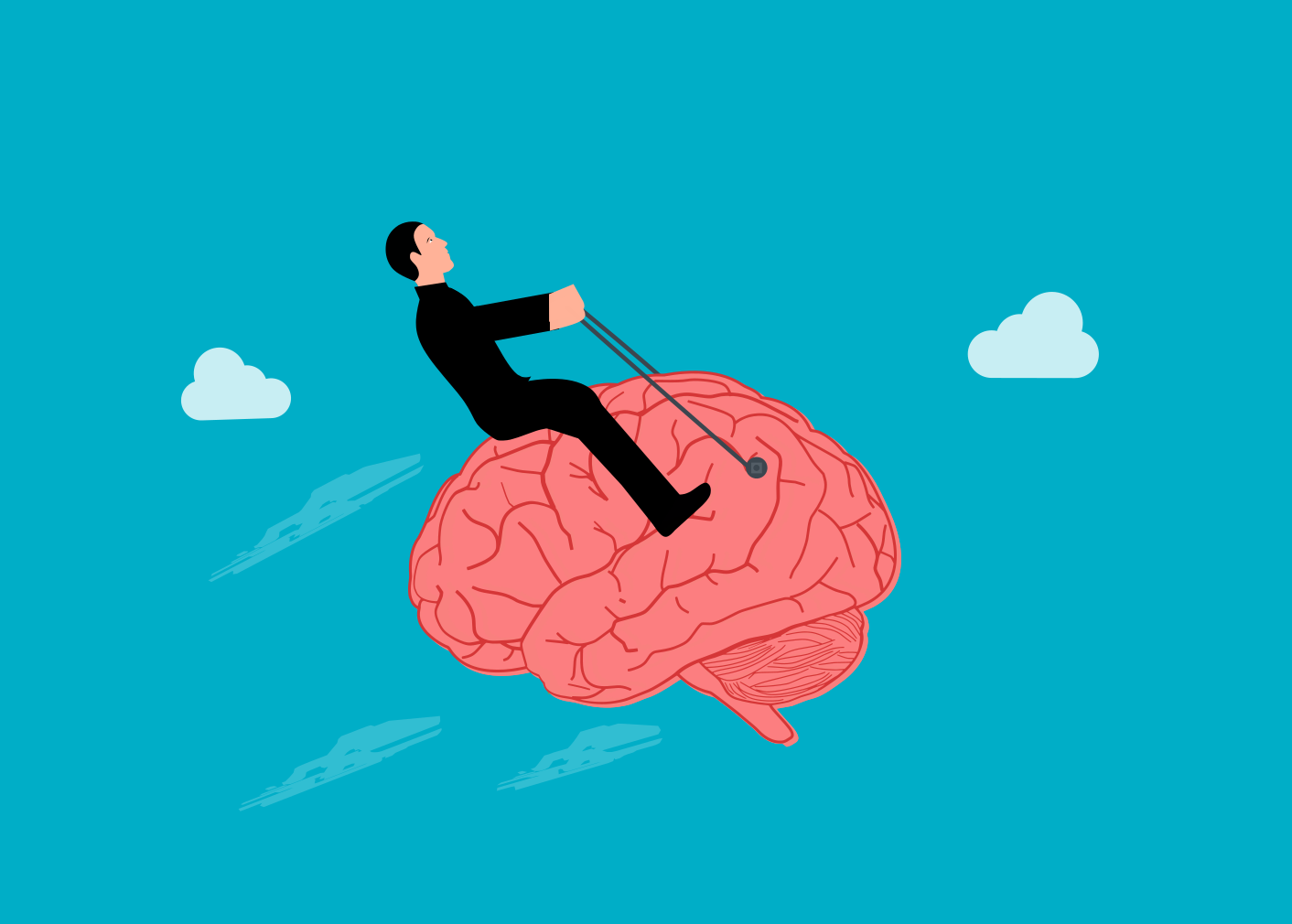
The principle at work resembles a switch. We cannot flip the emotion switch by hand, but we can flip the reason switch — and because the two switches are wired in opposition, turning on the reason switch is often enough to turn the emotion switch off.
This works the same way as the old trick for banishing an unwanted thought: telling yourself "don't think about an elephant" only guarantees you'll think of nothing else, but redirecting your attention to a donkey instead accomplishes what direct suppression could not. In the same way, rather than wrestling directly with an emotion, we can govern it by deliberately choosing an activity that engages reason.
When anger rises, instead of struggling to suppress the anger itself, the wiser move is to deliberately choose an action that demands rational thought.
"You cannot control your impulses, your emotions, as you may desire; but you can control the will, and you can make an entire change in your life." (Manuscript 121, 1898)
2. The Control of Stimulus
The second way to govern emotion is to govern the stimulus that produces it in the first place.
1) The Emotion Sensory Input Creates
A great many emotions arise directly from sensory input. An unpleasant sound leaves us upset and irritated; an unpleasant sight leaves us disgusted; unpleasant food leaves us in a worse mood, not a better one. In this sense, emotion is substantially subject to external circumstance, and it is inherently changeable.
Which means we need to learn the wisdom of governing emotion by governing the stimuli that produce it.
"Feelings are often deceiving, emotions are no sure safeguard; for they are variable and subject to external circumstances." (Testimonies for the Church, vol. 4, p. 188, 1876)
2) Avoiding the Stimulus
When a particular stimulus reliably produces a negative emotion, the most reliable response is simply to avoid it. If a certain person always makes you angry, reducing contact with that person is a practical solution. Doing this well, though, requires first identifying objectively which stimuli are actually producing the negative emotion — much like an allergy test.
Once you know which substance triggers the allergic reaction, you can avoid it and prevent the suffering altogether. One practical tool here is keeping an emotion journal for about a week; doing so tends to reveal rough patterns — which situations produce which emotions — that then become the basis for managing them going forward.
Scripture, too, warns against needlessly provoking negative emotion in others, particularly children.
"And, ye fathers, provoke not your children to wrath: but bring them up in the nurture and admonition of the Lord." (Ephesians 6:4, KJV)
Even words meant to encourage a child can, under the wrong conditions, become a stimulus that provokes anger instead. In our relationships more broadly, we need to understand which stimuli tend to produce negative emotion in the people around us, and act with that awareness out of consideration for them.
At the same time, we need to understand which stimuli tend to produce negative emotion in ourselves, so that we can protect our own hearts accordingly.
3) Changing the Stimulus
A more active way of governing stimulus is to change it outright — not merely avoiding the negative, but actively choosing the positive. This matters especially in the religious life, where many believers fall into spiritual discouragement or despondency. This tends to happen precisely when attention turns inward, toward the self. Almost no one, looking only within, can arrive at assurance of salvation, or at joy, or at hope. But looking instead to Christ — who accomplished salvation on our behalf — makes that assurance possible. This may be exactly why Scripture so consistently redirects our gaze toward Christ rather than toward ourselves.
"It is not wise to look to ourselves and study our emotions. If we do this, the enemy will present difficulties and temptations that weaken faith and destroy courage. To closely study our emotions and give way to our feelings is to entertain doubt and entangle ourselves in perplexity. We are to look away from self to Jesus." (The Ministry of Healing, p. 249, 1905)
3. The Control of Interpretation
The third way to govern emotion is to govern how we interpret events.
1) The Emotion Misunderstanding Creates
Human beings are, in a sense, reactive creatures — we respond to events with emotional, behavioral, and physiological reactions. When someone says something hurtful to us, we feel anger, an urge to retaliate, and a racing heart. But does everyone react identically to the same event? Clearly not.
Different people, faced with the same event, react in markedly different ways. Why? Because the interpretation of the event differs from person to person. In the end, we are not creatures who react to events themselves so much as creatures who react to our interpretation of events.
So why does interpretation differ from person to person? Because each of us interprets events through a different schema — a different interpretive framework. And schemas differ because the prior experiences that shaped them differ. Once a schema is in place, it becomes the lens through which every subsequent event gets read.
If someone walks past without greeting us, one person will interpret it as "they must not have noticed me," while another will interpret it as "they hate me now and won't even make eye contact." The latter interpretation typically emerges in someone who has already had one or two conflicts with that person in the past, and who now reads every subsequent action of theirs through the schema "this person hates me."
"Therefore judge nothing before the time, until the Lord come, who both will bring to light the hidden things of darkness, and will make manifest the counsels of the hearts: and then shall every man have praise of God." (1 Corinthians 4:5, KJV)
2) Choosing a Positive Interpretation
So how should we interpret events, then? The answer is to deliberately practice choosing the positive interpretation. We rarely know the full truth of an event, or the real motive behind another person's actions — which means a genuine zone of interpretation always remains open. When two interpretations are equally plausible, choosing the positive one over the negative one is simply the wiser course.
English has a phrase for this: giving someone the benefit of the doubt. It has also been said that love means placing the most generous possible interpretation on another person's motives and actions. Our built-in negativity bias tends to push us toward the negative interpretation, needlessly compounding our own suffering. It is worth practicing the opposite — choosing, deliberately, to interpret generously.
"Some indeed preach Christ even of envy and strife... What then? notwithstanding, every way, whether in pretence, or in truth, Christ is preached; and I therein do rejoice, yea, and will rejoice." (Philippians 1:18, KJV)
3) Treating Things as Expected, Not Exceptional
A second interpretive habit worth practicing is treating things as expected rather than as an affront. We rarely complain about, or grow angry over, something we already expect. Look closely at people who carry a great deal of anger, and you will often find that very little in their world counts, for them, as "to be expected." They grow angry precisely because they believe the offending thing should not have happened.
Consider David, fleeing Absalom's rebellion, cursed along the road by Shimei of the house of Saul. Most people in David's position would have reacted with fury and ordered the man's execution — cursing a king is, after all, an outrage that would seem to demand no tolerance whatsoever. Yet David called it expected. If David's own son was trying to kill him, was it really so strange that a man from a rival house should curse him too? We tend to set the bar for "expected" far too high.
Lower that bar even slightly, and a great deal of what once provoked our anger turns out to be perfectly understandable.
"And David said to Abishai, and to all his servants, Behold, my son, which came forth of my bowels, seeketh my life: how much more now may this Benjamite do it? let him alone, and let him curse; for the LORD hath bidden him. It may be that the LORD will look on mine affliction, and that the LORD will requite me good for his cursing this day." (2 Samuel 16:11–12, KJV)
4) Withholding Meaning
The final interpretive habit for governing emotion is choosing not to assign meaning at all. There is a saying that black ink thrown into the air can never stain the sky — because the sky simply refuses to receive it. Much of the hurt we feel from another person's words comes not from the words themselves but from the fact that we choose to receive them and give them meaning.
A well-known story tells of the Buddha, who once went to a household to receive alms and was met instead with harsh abuse from the owner of the house. The Buddha only smiled. Asked, in irritation, why he was smiling, he is said to have replied: when a guest brings a gift to your house, and you decline to accept it, whose gift does it remain?
Just so — if you hurl insults at me and I decline to accept them, whose insults do they remain? We do not go home upset because a dog barked at us on the street. That is because a dog's bark carries no meaning for us to begin with — it may startle us, but it does not leave us feeling wronged or resentful. In the same way, we need the freedom that comes from refusing to load excessive meaning onto sounds that, in themselves, carry none.
"Also take no heed unto all words that are spoken; lest thou hear thy servant curse thee: for oftentimes also thine own heart knoweth that thou thyself likewise hast cursed others." (Ecclesiastes 7:21–22, KJV)
Conclusion
To govern emotion is not to suppress it or deny it. It is closer to a form of wisdom: understanding the pathways by which emotion is formed, and finding the points of leverage within those pathways where intervention is actually possible. We cannot flip the emotion switch by hand — but we can give reason the time it needs, flip the switch of reason instead, examine and adjust the stimuli that provoke emotion, and deliberately choose how we interpret the events around us.
The control of reason, the control of stimulus, and the control of interpretation are not mutually exclusive strategies; they work together, interlocking. A life not driven by emotion is not a life without emotion — it is a life in which reason knows how to step in wherever emotion happens to pass through.
Notes
Lieberman, M. D., Eisenberger, N. I., Crockett, M. J., Tom, S. M., Pfeifer, J. H., & Way, B. M. (2007). Putting feelings into words: Affect labeling disrupts amygdala activity in response to affective stimuli. Psychological Science, 18(5), 421–428.
White, E. G. (1876). Testimonies for the Church, vol. 4, p. 188.
White, E. G. (1898). Manuscript 121.
White, E. G. (1905). The Ministry of Healing, p. 249.


